
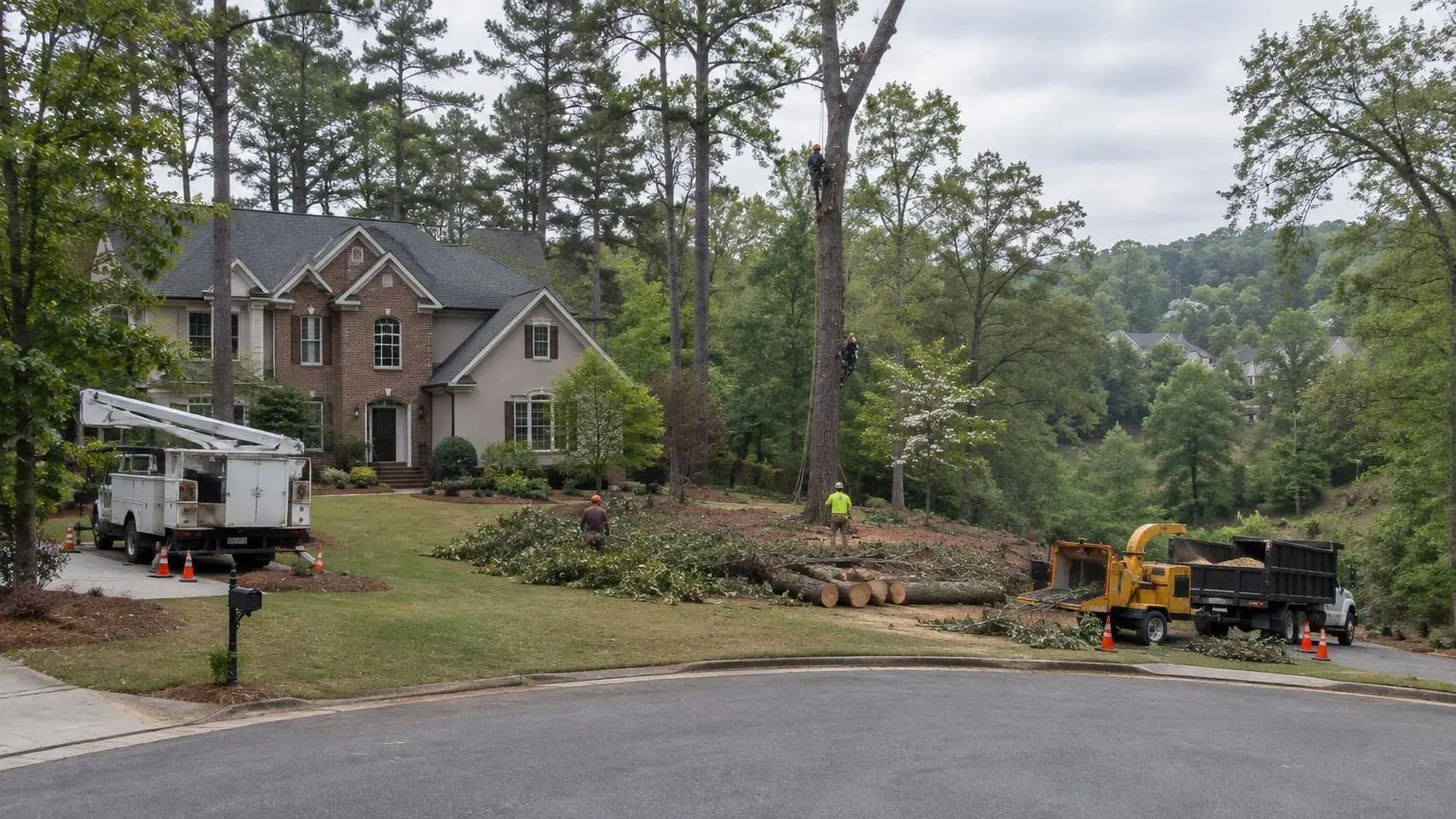
Mature neighborhoods at the top of DeKalb County
Tree Service in Dunwoody, GA
Trees planted or spared when the subdivisions went in are now 60 years older.
- Free visits to quote jobs throughout Alpharetta and nearby towns
- You get the price in writing, tree by tree
- We agree on haul-off before day one
Sixty-Year-Old Neighborhoods, Sixty-Year-Old Trees
A lot of the Tree Service calls we get in Dunwoody trace back to the 1960s and 1970s. Dunwoody was largely rural until suburban building started then: Georgetown near I-285 in the early 1960s, Perimeter Mall and Dunwoody Village in 1971, and street after street of ranches and colonials afterward. The oaks, poplars and pines left standing during that construction are now big, tall and close to the houses built under them.
No permit on most single-family lots
Dunwoody's tree page is clear: on a single-family lot, outside the 75-foot stream buffer, a tree removal permit is not required. That is a real difference from Sandy Springs next door. Inside the buffer, removal needs a permit and an arborist report, and the tree must be dead, diseased or dying, or hazardous to avoid a variance. Unpermitted work in the buffer can bring citations of up to $1,000 per violation.
There is one more rule worth knowing. The city has a minimum tree density, and if a lot does not keep enough trees for its square footage, the owner has to plant new ones. A removal that is fine today can still lead to a replanting request if the lot comes under review later, such as during a building permit for an addition.
The 1998 tornado
On April 8, 1998, a tornado tracked east-northeast from Perimeter Center into Gwinnett County. Thousands of homes were damaged and tens of thousands of native trees came down; long-time residents still call it the Dunwoody tornado. The lesson for today is simple: a heavy tree with decay at the base or a root plate already lifting is the one that fails in high wind.
What Dunwoody yards usually need
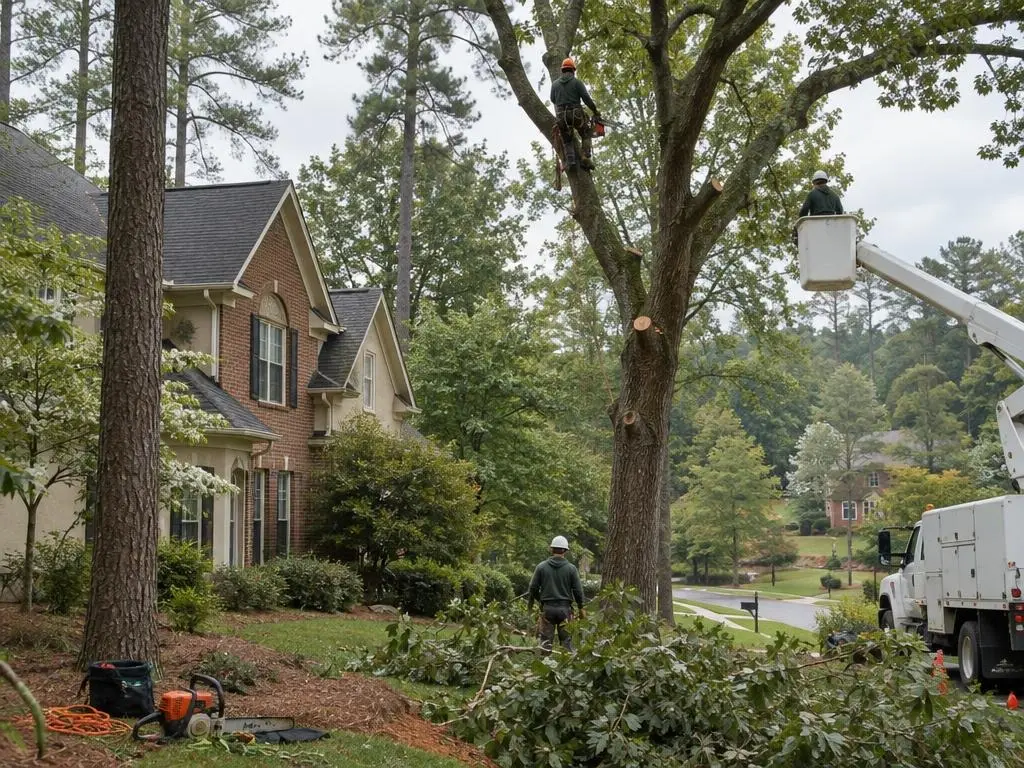
- Removing over-mature pines and water oaks leaning toward roofs
- Crown cleaning to take dead wood out of big white and red oaks
- Clearance pruning over driveways and along the street
- Stump grinding for owners redoing yards, pools or additions
- Work on lots near Brook Run, the Twin Lakes reservoir and neighborhood creeks, where buffers can apply
During Helene in 2024, roads in the Vernon neighborhoods and along Peeler Road closed for downed trees, a pattern that repeats in most big storms here.
Call (770) 758-8959 or use the form. We will look at the trees, check whether a buffer is involved, and give you a written estimate.
Dunwoody Notes
- Single-family permits. Dunwoody does not require a tree removal permit on single-family lots outside the 75-foot stream buffer; inside it, removal needs a permit and an arborist report.
- Tree density. Under Sec. 16-109(b)(2), lots that do not preserve enough trees for their square footage must plant new trees to meet the city's minimum density.
- 1998 tornado. The April 8, 1998 tornado tracked from Perimeter Center into Gwinnett, damaging thousands of homes and downing tens of thousands of native trees.
- Housing era. Suburban development began in the 1960s; Georgetown was built in the early 1960s and Dunwoody Village and Perimeter Mall in 1971.
- Settled households. Census QuickFacts reports 89.1% of residents living in the same house a year earlier and a $602,900 median owner-occupied value (2020-2024).
Dunwoody Questions
Can I remove a tree in my Dunwoody backyard without a permit?
On a single-family lot outside the 75-foot stream buffer, yes. If a creek runs behind your house, check the buffer line first, because work inside it needs a permit.
What does the city need for a stream-buffer removal?
An application, an aerial site plan from the city's SmartMap with the trees marked, photos of each tree, the fee and an arborist report showing the tree is dead, diseased or hazardous.
Our oak survived 1998 but looks thin now. Is it dying?
A thinning crown on an old oak can come from root damage, drought or decay. It is worth having someone look at the base and the upper crown. Some trees just need deadwood removed; others are near the end.
Do you grind stumps for additions and pools?
Yes. Grinding below grade lets builders dig footings and lets new lawn or beds go in. Mention the project at the estimate so we grind deep enough.
Who handles a tree on city property, like a park or right-of-way?
Dunwoody's tree page lists a contact for trees on public property, Amy Bledsoe at 678-382-6820. Trees on your own lot are yours to manage, even if they lean over the street.
Are the big pines in Dunwoody more dangerous than the oaks?
Not by default. Tall pines catch a lot of wind and show trouble quickly when they die, while big oaks tend to fail from hidden decay or root damage. Each tree gets judged on its own condition: crown, trunk, base and the ground around it.
Free Estimates in Dunwoody, GA
Free estimates across Dunwoody, from Georgetown to the Vernon neighborhoods.
Tree Service Near Dunwoody
- Tree Service in Alpharetta, GA
- Tree Service in Roswell, GA
- Tree Service in Milton, GA
- Tree Service in Johns Creek, GA
- Tree Service in Sandy Springs, GA
- Tree Service in Cumming, GA
- Tree Service in Suwanee, GA
- Tree Service in Duluth, GA
- Tree Service in Peachtree Corners, GA
- Tree Service in Norcross, GA
- Tree Service in Berkeley Lake, GA
- Tree Service in Sugar Hill, GA
- Tree Service in Buford, GA
- Tree Service in Brookhaven, GA
- Tree Service in Chamblee, GA
- Tree Service in Doraville, GA
- Tree Service in Tucker, GA
- Tree Service in Lawrenceville, GA
- Tree Service in Mountain Park, GA
- Tree Service in Crabapple, GA
- Tree Service in Lilburn, GA